The Source, or the Surf? Why Surfs Up Matters
Surfs Up is a surfing game made in Godot, built to capture the spirit of Source surf without being chained to the Source engine itself.
That alone is enough to make some people skeptical.
For a lot of players, surf is inseparable from Counter-Strike: Source. That is where they learned it, where they built their muscle memory, where they spent hundreds or thousands of hours replaying maps and shaving seconds off runs. Surf started as an accident, a weird bit of physics that turned sliding on ramps into one of the most satisfying movement systems in multiplayer games. What if it was no longer an accident?
I think Surfs Up is a logical next step in the evolution of surf.
Old habits
There are a few objections I hear over and over.
The first is that the physics are not a perfect match with Source. For high level players especially, that matters. When someone has years of muscle memory drilled into their hands, even slight differences can feel wrong.
The second is convenience. A lot of people already have Counter-Strike installed, or they are comfortable staying inside Momentum Mod. If what they already use works, why change?
The third is optimization. Some players have tried Surfs Up, run into performance issues, and written it off instantly.
Those are all understandable criticisms. I do not think surf players are irrational for making them. I just think they are too hasty.
Why physics not being identical is a good thing
This is the biggest point, and probably the one most likely to annoy people.
I do not think Surfs Up needs to be a perfect Source copy to justify existing. In fact, I think trying to be a perfect copy would limit what it can become.
Source surf was an accident. The community took that accident and turned it into something incredible, but the underlying systems were never made for surf in the first place. Surf in Source has always had to live inside a framework that was built for entirely different games. It has always been adapting, compensating, and working around systems that were not designed with surf as the priority.
That is why I find Surfs Up so interesting. It is not trying to strap surf onto the back of a game that has other priorities. It can tune its mechanics directly in service of surf itself. Every decision can be about how the movement feels, how maps flow, how speed builds, how players learn, and what makes the surfing better as a whole.
To the people who say it just feels off, I would genuinely ask for a little more patience. Of course it feels off at first. If you dropped a football player into a rugby match, they would feel out of place too. That does not mean the sport is broken. It means they are learning a different ruleset with different instincts. Given enough time, they adapt.
I think people who love surf in Source can learn to love Surfs Up too, if they give it enough room to become its own thing instead of only judging it by how precisely it recreates old habits.
And if that is still not convincing, there is another factor that matters a lot to me: Mark, the developer behind Surfs Up, actually listens. Not in the vague, corporate way developers sometimes say they are listening. He is regularly in the Discord, often in voice chat, hearing people out directly. If you are respectful and serious about the game, there is a real chance your feedback actually reaches the person shaping it.
“One of my buddies said they found a good Surf game and I should try it. I was horrible at first, and my friends would shit talk me a ton. This drove me to solo grind the game to get better, one day a random dude joined my lobby and I found out it was the developer of Surfs Up. It was Mark. At that point he invited me to the discord and I just talked to him. I thought it was cool that they made their own maps, then he showed me the SDK. I made my first map named SPKY within a few days and then Mark added it the same day I finished making it. A lot of the community was saying it didn’t look very good visually, which just gave me desire to improve. Now I have about 12 maps in the game, and I have no plan of stopping. Just like Mark has no plan in stopping, I’ve said that he is the only developer that can put 32 hours of work in a 24 hour day.”
Spanky, prominent surfer and map maker
Why not just stay with Counter-Strike or Momentum Mod?
This is probably the most practical objection, and it is the one I think people underrate.
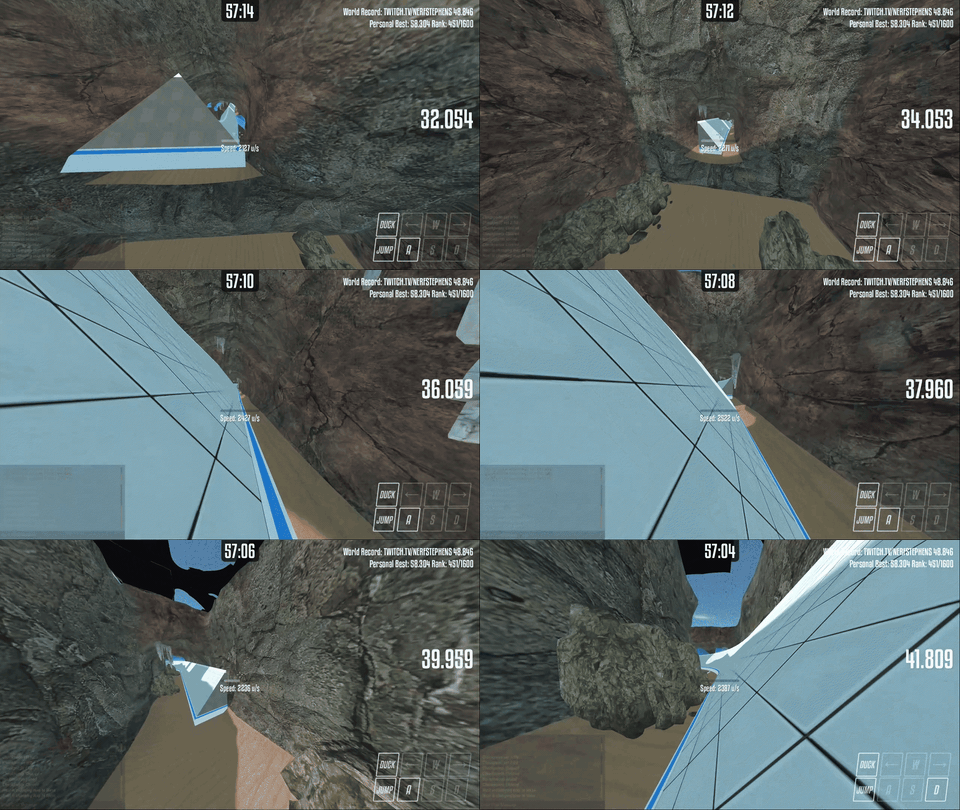
If you mainly play surf and do not actually care about the rest of Counter-Strike, then loading up a full game just to access a surf mode starts to feel a little ridiculous. You are carrying around a whole game ecosystem when the thing you actually want is surf.
And if you are on Momentum Mod, the situation is different but not necessarily simpler. Momentum Mod is great, and I do not think Surfs Up is in some direct war with it. They are trying to do different things. To me, Momentum Mod is focused on Source accuracy. Surfs Up is focused on surf accuracy.
That distinction is my main point.
Momentum Mod still leans on assets and textures from other Source games like Counter-Strike, Team Fortress 2, and Half-Life. There are workarounds, and yes, you can strip things down if you really want to. But it is not exactly elegant, and not everybody wants to spend their free time doing file surgery just to make a movement game run the way they want.
Surfs Up has a huge advantage here: it is built in Godot.
That does not just matter for the players. It matters for the future of the community, because it matters for mappers.
Godot is dramatically more approachable than the old CAD-like workflows many people associate with Source mapping tools. I have made maps for Surfs Up, and the experience was refreshingly straightforward. The hard part was designing the map well, not fighting the editor. That is exactly how it should be.
“I didn’t know about Godot until I met Mark. I never touched anything with making maps (or anything online) before. With Mark, and Spanky’s guidance I was able to make a map in 1 week. It wouldn’t have been possible without Mark’s SDK for map making. I felt this sense of accomplishment seeing the community play my map. It was amazing. I’ve never seen a developer or anyone who makes anything in general respond so fast, and so well to their community. He cares so much about the community, he lets everyone know what’s happening, what the problems were, and how he fixed it. This is with every facet of the game.”
Darridon, Surf Rank #3 globally and up-and-coming map maker
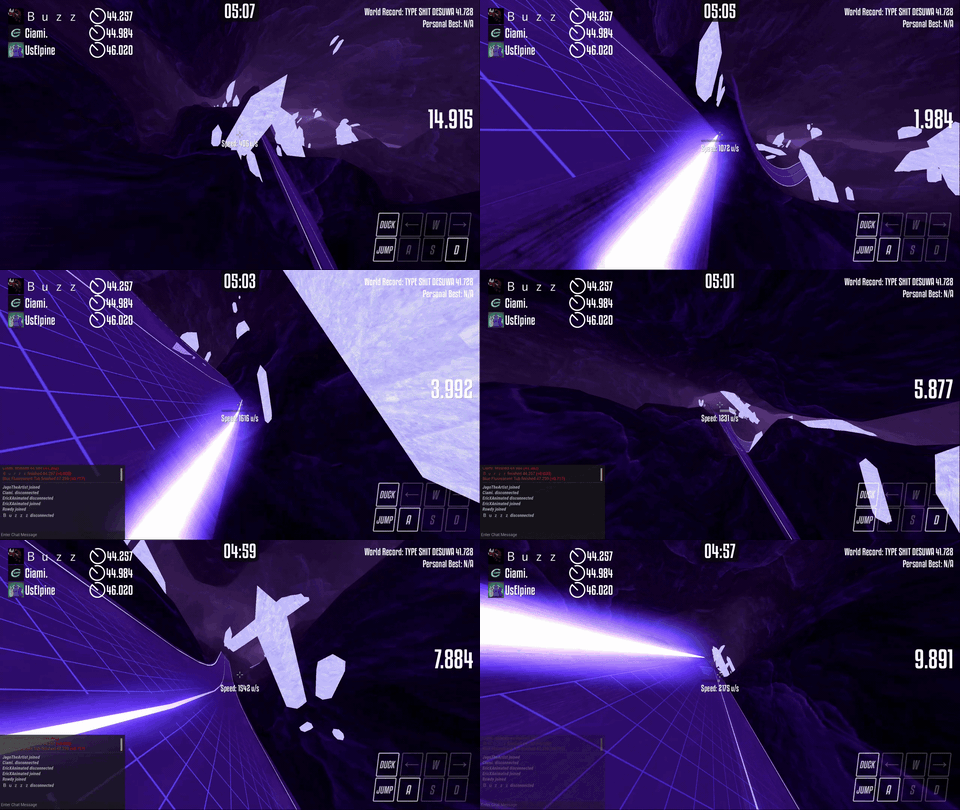
And for the people who love the old tools and do not want to leave them behind, there is still a bridge back. Surfs Up supports importing maps, which means people who are comfortable with that older workflow are not being told to throw away everything they know. They can bring that experience with them while newer creators can enter through a much more accessible door.
That is one of the strongest arguments for the game, in my opinion. A free game focused entirely on surf, with easier map creation, more room for experimentation, and a welcoming community, is not just good for one developer. It is good for surf as a whole. Even if someone is not ready to fully migrate, I have a hard time understanding why they would not want more maps, more creators, and more ideas entering the scene.
“I had been making surf maps and deathmatch maps for quakeworld for about a year or two and was getting pretty frustrated with the tooling and limitations of the engine. I was in another discord and they said something about Surfs Up getting released so I joined to check it out. I was pretty intrigued by Godot and all the things that I could do in that engine so I knew I had to try to make a map. I talked to Mark about mapping and showed him some of my quakeworld stuff and he seemed really impressed by it and was just such a nice dude to talk to. I would show him stuff I was working on and he would keep encouraging me to get more familiar with Godot when I would get frustrated. It’s so cool how creative this game has made me because I also like making textures and this pushed me to get better at using Material Maker so I could make my maps look the way I wanted. I really appreciate Mark giving me this outlet to explore that. It’s been a really great way for me to relax. It’s been really cool to see people playing my maps and I gotta thank Mark for including me in his game.”
Any_other, popular map maker
What about the optimization?
This is the easiest criticism to grant, because it is true that optimization matters. People should not have to pretend performance issues are fine just because a project is promising.
But again, this is where the human side of the project matters.
Mark is not absent. He is not hiding from the problem. He is right there, typing his fingers down to the bone. He hears what people are saying, and from everything I have seen, he is actively working on it. This is not just the vague sense of “we are looking into it,” but the real effort of someone grinding away at the game because he believes in it.
There is also significant work going on under the hood, with major updates to the codebase aimed at better optimization, smoother usability, and a stronger overall foundation. If those improvements deliver as people hope, the game should not only run better but also lay the groundwork for future growth.
It’s worth noting that the map making side is not just an extra or afterthought. Mark is making the SDK for maps a central focus of development. Improving these tools is treated as a key part of the game’s direction, not just something on the sidelines.
That does not mean people need to ignore the current state of the game, which is in a great state now compared to release. It just means there is a difference between a project with rough edges that is being actively improved and a project that has already hit its ceiling.
The source, or the surf?
Surf has always been niche, and niche communities often get protective. I get that. When something matters to you, change can feel scary even when it is actually growth.
But I think this is one of those moments where the community has to ask itself what it really values most.
Is the goal to preserve the exact circumstances that gave birth to surf, no matter how limiting those circumstances are?
Or is the goal to keep surf alive, healthy, and evolving?
That is why I care about Surfs Up. Not because it is a perfect replacement for Source. Not because everyone should uninstall everything else tomorrow. But because it feels like a serious attempt to build a future for surf that belongs to surf.
I just want to see more people try it with an open mind. The more honest feedback and real conversation about what’s good and what isn’t, the better. In the end, it really comes down to this:
Are we here for the source, or for the surf?